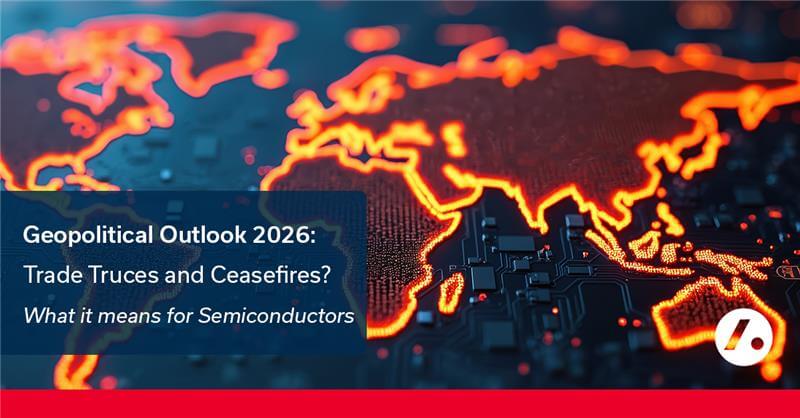
Geopolitical Outlook 2026: “Trade Truces and Ceasefires?” — What It Means for Semiconductors

Key Takeaways from Matt Gertken, PhD (BCA Research) at SEMI ISS
By Damian Scandiffio
One of the most valuable sessions at SEMI ISS last month wasn’t about a single country, conflict, or policy headline. It was about something bigger: how the global system is changing underneath all of them. Matt Gertken’s geopolitical outlook for 2026 delivered a framing that stayed with me. Geopolitical risk is structurally elevated for the long run, but 2026 may be a “sideways” year. Not calm, not stable, but contained as long as major-power communication channels stay open.
Here’s what that means in practical terms and why it matters for the semiconductor industry.
The Post-WWII Order Is Breaking Down
Gertken’s core argument is that today’s disruptions aren’t random. They stem from the slow erosion of the global “peace settlement” built after World War II. That system supported decades of globalization and predictable economic expansion, but according to his analysis, it’s fraying.
China’s rise is central to this story. The United States designed the postwar system, and China grew powerful within it without shaping its rules. According to Gertken, China now seeks to revise the structure, creating long-run competition and more frequent friction. Geopolitics has become embedded within domestic policy decisions across major economies, creating what he describes as policy whiplash and higher uncertainty, a structural shift rather than a temporary phase.
Expect Volatility, Not Escalation
Gertken’s 2026 outlook wasn’t reassuring, but it wasn’t apocalyptic either. His message: expect incidents, spikes, and noise, but don’t assume step-change escalation is the most likely outcome. The key condition? The efforts to ease tensions remain intact, meaning the major powers keep talking rather than amplifying tensions.
This matters because volatility and escalation are different things. Volatility means sharp, short-term disruptions that move markets but don’t fundamentally break the system. Escalation means the system itself is at risk. In 2026, according to this analysis, we’re more likely to be dealing with the former.
Ukraine: A Ceasefire Is Likely, but Incidents Will Still Shock Markets
Gertken assigned rough probabilities to Ukraine outcomes: about 55% chance of a ceasefire within 12 months, 35% chance of a contained status quo, and 10% chance of major escalation involving Russia and NATO. Those numbers suggest the base case is moving toward resolution, not escalation.
However, even on a ceasefire trajectory, volatile incidents such as sabotage, drone strikes, infrastructure attacks, or provocations can create sharp market reactions, especially if casualties spike. These events move markets fast, even if they don’t change the ultimate trajectory. The path to de-escalation, in this view, won’t be smooth.
U.S.–China: A Trade Truce Is Plausible, but the Rivalry Continues
Gertken described 2026 as a year where neither Washington nor Beijing wants to go “full offensive.” The United States is in a midterm cycle and seeks lower inflation pressure. China remains export-dependent and is navigating economic challenges. According to this analysis, neither side benefits from escalation right now, which creates space for a “trade truce.”
This doesn’t necessarily mean a formal agreement; a trade truce might simply mean both sides reduce confrontational measures temporarily, which can reduce near-term volatility. However, it doesn’t resolve the structural competition. The underlying rivalry over technology, supply chains, and global influence persists.
Taiwan: The Real Risk Is Gray-Zone Pressure, Not Invasion
Taiwan is the central long-run flashpoint, but the near-term story is more subtle. Gertken emphasized the obstacles to invasion: amphibious complexity, Taiwan’s preparedness, and Japan’s increasing willingness to treat Taiwan’s security as directly tied to its own. An invasion isn’t the base case in this analysis.
What’s more likely? Gray-zone tactics, coercion, probes, and limited moves are designed to test resolve without triggering full-scale conflict. Gertken noted that major powers are increasingly thinking in terms of spheres of influence. He framed the probabilities as roughly two-thirds for status quo or manageable escalation, and one-third for major escalation scenarios, with a proxy-style move more plausible than total war.
Why does this matter to semiconductors? Because a serious Taiwan disruption isn’t just a geopolitical headline, it represents a potential multi-trillion-dollar economic shock. The global chip supply chain runs through Taiwan. Any major disruption there would cascade throughout the entire technology ecosystem.
The Fed and the Real “Cliff Risk”
Gertken made another critical point: the greatest market shock in 2026 wouldn’t necessarily come from geopolitical developments. It could come from a loss of credibility around price stability, specifically, if markets believe central bank independence is compromised. When that happens, yields rise, risk assets fall, capital gets more expensive, and markets experience significant volatility.
His assessment? Institutional guardrails still exist, but this represents one of the most important “cliff risks” to monitor. The question is whether these institutions maintain their credibility and independence.
What This Means for Semiconductors
For the semiconductor ecosystem, 2026 isn’t shaping up as a clean escalation year. It’s shaping up to be a year of persistent volatility, stressed supply chains, policy adjustments, and isolated incidents that drive sudden market swings. However, the base case in this analysis still leans toward managed tension rather than systemic breakdown.
That’s not comforting, but it is actionable. Success won’t come from predicting a single outcome. It will come from planning for multiple scenarios, building resilience into operations, and maintaining the agility to adapt when conditions shift. In a sideways year, flexibility becomes a competitive advantage.